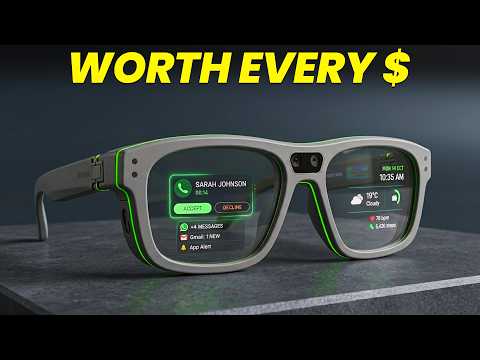
AI smart glasses in 2026 are moving from niche gadgets to serious smartphone alternatives, offering hands‑free messaging, real‑time translation, camera‑aware AI, and lightweight augmented reality (AR) overlays directly in your field of view. Instead of pulling out a phone, users can look at objects, listen to conversations, or speak short prompts and get instant assistance—transcriptions, translations, navigation cues, and contextual information—through subtle displays and audio.
Industry watchers and creators describe 2026 as the “breakout year” for smart glasses, driven by better AI models, smaller hardware, and aggressive launches from Meta, Google, and fashion brands like Warby Parker and Gentle Monster. At CES 2026 and other events, demonstrations of real‑time translation in noisy halls and context‑aware AR experiences show how close smart glasses are to becoming everyday computing companions, even as concerns about privacy, social acceptance, and long‑term comfort remain.
The 2026 Smart Glasses Surge
A February 2026 analysis calls this year a “smart glasses surge,” arguing that AI and AR eyewear are finally moving beyond prototypes into mainstream consumer and professional markets.
Modern smart glasses let users take photos, stream video, and interact with AI assistants like Meta AI or Google Assistant, using cameras, microphones, and speakers embedded in normal-looking frames.
They deliver notifications, capture content, trigger smart home devices, and provide on‑the‑go AI help (summaries, recommendations, visual search) with far less friction than smartphones.
Commentators note that early Meta Ray‑Ban glasses pioneered this direction, and 2026 brings more brands with similar AI-centric designs at various price points.
Why 2026 Feels Like “Smart Glasses vs. Smartphone”
CNET and other tech outlets argue that 2026 is when smart glasses “come for your face,” making a serious claim on tasks usually handled by phones.
Warby Parker and Gentle Monster are expected to ship smart glasses that lean heavily on camera‑aware AI, similar to Meta’s approach but with more style and potentially tighter integration with ecosystems like Google or Samsung.
A CNET feature highlights glasses that provide hands‑free AI, live translation, and AR that can map your face and surroundings, suggesting that some interactions—taking calls, getting directions, quick queries—may shift from phones to eyewear for many users.
A LinkedIn forecast calls 2026 “the breakout year for smart glasses,” noting that headsets which once felt like heavy prototypes are now smaller, more fashionable, and backed by robust AI platforms.
Real-Time Translation: The Killer Use Case
Live translation in the noisiest environments
Early 2026 CES demos show smart glasses performing real-time translation even in loud exhibition halls.
One tester reports using AR smart glasses with real-time translation “in one of the loudest exhibition environments,” and the experience “really feels” like the future as the system overlays translated text on what the user hears.
Another social post describes 2026 AI glasses as “designed to understand your surroundings, translate conversations in real time, summarize what you’re seeing and hearing, and overlay helpful information over the real world.”
These examples showcase how multimodal AI (audio, vision, language) plus edge processing make translation fast enough to be conversational, not just a novelty.
How it works in practice
Modern AI glasses combine:
Microphones and beamforming to isolate speech in noisy environments.
On-device or near-edge speech recognition and translation models to minimize latency.
Small displays (waveguides, micro-OLED) or audio to present translations discreetly.
Users can see subtitles floating near people they talk with or hear translations through bone-conduction audio, effectively turning glasses into live interpreters that travel with them.
AR Breakthroughs: Context-Aware Overlays, Not Full VR
The AR in 2026 smart glasses is mostly “lightweight AR”—contextual overlays and prompts, not full 3D worlds.
AI and sensors allow glasses to understand environment and context: identifying people, objects, and places, then providing relevant information (names, cues, instructions) in a subtle HUD.
Use cases include navigation arrows on streets, labels and instructions for tools in a workshop, reminders during meetings, and hands‑free step-by-step instructions for tasks.
Cybernews notes that AI glasses in 2026 range from audio-only models (reading messages, taking notes) to AR/XR frames that enhance reality with visual elements or streaming content, effectively turning the world into a just‑in‑time info surface.
Major Players and Ecosystems
Meta, Ray‑Ban, and camera-aware AI
Meta’s Ray‑Ban smart glasses set early expectations for casual, camera-aware AI.
They let users record, stream, and ask Meta AI questions about what they are seeing; 2026 variants and competitors build on this with better cameras and more powerful AI models.
Reviews anticipate expanding capabilities like object recognition, shopping assistance, and memory aids (e.g., “what did this person say last time?”) as Meta’s models improve.
Google’s AI glasses bet
Google is widely reported to be planning advanced AI glasses for 2026, focusing on real-time assistance and AR overlays.
According to a December 2025 briefing, these glasses will emphasize contextual understanding—recognizing what the user is doing and offering help proactively.
This could integrate tightly with Google services (Maps, Search, Workspace), giving Google a strong position in enterprise and productivity use cases.
Other brands and the broader ecosystem
Warby Parker and Gentle Monster are expected to launch smart glasses that blend fashion with camera-aware AI and platform integration.
Multiple “best AI glasses 2026” roundups list options from tech giants and smaller players, with differentiation in form factor, AR capabilities, and ecosystem lock‑in.
This competitive landscape suggests a smartphone-like platform battle, but on your face instead of in your pocket.
Positive Scenarios: Real Value Across Sectors
Accessibility and inclusion
AI smart glasses can dramatically improve accessibility:
Real-time captioning and translation help deaf, hard-of-hearing, and multilingual users participate more fully in conversations and events.
Visual recognition features can help visually impaired users identify objects, read signs, and navigate unfamiliar spaces.
These capabilities can reduce barriers in education, work, and public life if devices are affordable and well-supported.
Productivity and field work
For many jobs, glasses are more natural than phones or tablets:
Technicians, warehouse workers, and field engineers can receive hands‑free instructions, checklists, and visual cues while keeping both hands free.
Knowledge workers can get subtle prompts, summaries, and translations in meetings without constantly checking screens.
AI in transportation and industry guides list smart glasses as key tools for augmented workers in logistics, manufacturing, and maintenance.
Social and everyday life
In everyday scenarios, glasses can reduce “screen obsession”:
Quick queries, navigation, notifications, and media capture can happen through subtle interactions instead of constant smartphone use.
For travel, live translation, contextual tips, and AR navigation create smoother, less stressful experiences.
Creators argue that, when done right, glasses can make technology feel more ambient and less addictive than phones.
Negative Scenarios and Critical Concerns
Privacy and surveillance
Always-on cameras and microphones on faces raise substantial privacy issues:
Bystanders may be recorded or analyzed by AI without clear consent, especially as glasses become more discreet.
Real-time face mapping and object recognition could be misused for profiling, targeted advertising, or surveillance, especially if data is stored centrally.
Past backlash against Google Glass shows that social norms matter; 2026 devices must navigate stricter privacy expectations and regulations.
Data, lock-in, and monetization
Smart glasses deepen platform dependence:
Companies that control glasses OS, AI models, and cloud services gain access to intimate data about where you look, what you hear, and how you move.
Business models may push aggressive data monetization and targeted ads, potentially turning your field of view into an ad surface if not tightly regulated.
This raises questions about data ownership, interoperability, and whether users can truly opt out or switch providers.
Health, comfort, and social acceptance
Long-term impacts are still unclear:
Wearing display-equipped glasses all day may cause eye strain, distraction, or cognitive overload if notifications and AR overlays are poorly designed.
Social discomfort persists around people wearing cameras in intimate or sensitive spaces; norms will evolve, but conflict and backlash are likely if transparency is low.
These factors may limit adoption in certain environments (schools, clinics, government offices) unless strict policies and device modes exist.
Real Contribution to Progress—and What to Watch Next
If guided well, AI smart glasses in 2026 can contribute meaningfully to:
Communication and understanding: Breaking language barriers with real-time translation and captioning.
Augmented work and learning: Delivering just‑in‑time information and instructions in context, boosting productivity and safety.
Digital well‑being: Moving some interactions off screens and into more ambient, glanceable experiences.
But this “replacement” of smartphones is not purely positive. Without careful design and regulation, AI smart glasses could expand surveillance, deepen platform lock-in, and normalize constant digital overlay on reality.
How AI Smart Glasses Are Replacing Smartphones: Real-Time Translation and AR Breakthroughs in 2026 is, ultimately, a story about shifting interfaces. The core question for 2026 and beyond is whether we build this new interface layer to be respectful, human‑centered, and privacy‑preserving—or whether we repeat the mistakes of the smartphone era with even less visible technology sitting directly on our faces.