Most Powerful Banks on Earth: Meet the $100+ Trillion Global Banking Elite
In 2026, the fifty largest banks on earth control more than 100 trillion dollars in combined assets, with a tightly concentrated “elite” led by China’s state‑owned giants and a handful of U.S., European, and Japanese powerhouses. These institutions are not just big balance sheets: they shape credit flows, jobs, trade, and even geopolitical leverage across the global economy.
The $100+ Trillion Global Banking Wall
Recent 2026 analyses of the world’s 50 largest banks show that they hold roughly 101.6 trillion USD in total assets—an amount comparable to the entire global stock of government debt. These rankings consistently highlight three structural facts:
A small core of about 10–15 megabanks dominates the top of the list, each holding between 2.5 and 7.5 trillion USD in assets.
Chinese banks occupy the top four positions by total assets and account for around 40% of the asset base of the top 50, reflecting decades of state‑driven expansion and high domestic savings.
U.S., European, and Japanese banks remain central to capital markets, dollar and euro funding, and cross‑border finance, even when they rank below the Chinese “Big Four” by sheer size.
This “wall” of more than 100 trillion USD is the backbone of global credit creation and liquidity: when it expands, capital becomes cheaper and projects proliferate; when it contracts, investment slows, credit tightens, and employment can suffer.
Who Are the Core Elite?
Across multiple 2026 rankings focused on total assets, the same names keep appearing in any realistic “global banking elite” short list. At the very top are the Chinese state‑owned megabanks:
Industrial and Commercial Bank of China (ICBC) – the world’s largest bank, with roughly 7.3–7.6 trillion USD in assets.
Agricultural Bank of China (ABC) – close to 7 trillion USD in assets, deeply embedded in rural finance and infrastructure.
China Construction Bank (CCB) – about 6.2–6.5 trillion USD, heavily exposed to housing and large projects.
Bank of China (BOC) – around 5.3–5.5 trillion USD, the most internationally oriented of the four, with extensive trade‑finance and overseas operations.
They are joined at the “elite” level by Western and Japanese giants such as:
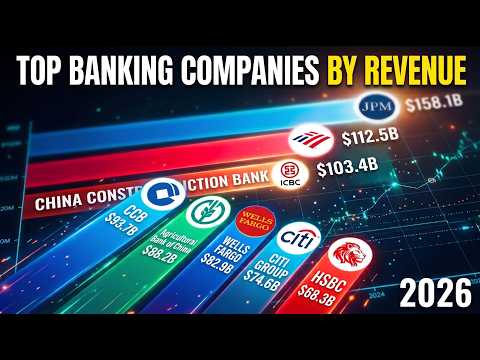
JPMorgan Chase – roughly 4.4–4.6 trillion USD in assets and often ranked the world’s most valuable bank by market capitalization.
Bank of America – around 3.4 trillion USD in assets, a dominant U.S. retail and corporate bank with global investment‑banking reach.
BNP Paribas – about 3.3 trillion USD, Europe’s largest bank by assets.
HSBC – around 3.2 trillion USD, UK‑headquartered but Asia‑centric.
Crédit Agricole – roughly 2.8–3.1 trillion USD, a French cooperative‑rooted universal bank.
Mitsubishi UFJ Financial Group (MUFG) – about 2.7 trillion USD, the main Japanese pillar in global wholesale funding and project finance.
Together, these institutions form the “heaviest hitters” in global banking: they sit at the intersection of deposits, loans, securities, and derivatives markets in every major region.
Why These Banks Are So Powerful
The power of this global elite goes well beyond balance‑sheet size. Three dimensions matter in practice:
Control of Credit and Liquidity
These banks provide the bulk of large‑ticket corporate loans, project finance, and trade‑finance facilities that allow multinationals, governments, and large infrastructure projects to function.
Their risk appetite directly affects whether capital is plentiful or scarce for sectors like energy, transport, technology, and manufacturing.
Market Infrastructure and Payments
U.S. giants like JPMorgan and Bank of America operate vast payments, settlement, and custody platforms—moving trillions in daily flows and serving as crucial pipelines for the U.S. dollar system.
European and UK players like BNP Paribas and HSBC are central to euro, sterling, and cross‑border flows; Japanese banks underpin yen funding and carry trades.
Geopolitical and Regulatory Influence
Chinese megabanks reflect and implement state priorities—funding domestic stimulus, Belt and Road projects, and strategic industries.
Western banks strongly influence global standard‑setting on risk, ESG, and fintech through their interactions with regulators, central banks, and international bodies.
When these banks align with policy goals, they can amplify state strategies; when they pull back or misjudge risk, they can undermine growth and financial stability far beyond their home countries.
Positive Contributions: What the Elite Does Right
Viewed from the perspective of workers, companies, and communities, the global banking elite can deliver substantial benefits when managed responsibly:
Financing Growth and Infrastructure
These banks have financed highways, ports, airports, power plants, data centers, and telecom networks that underpin modern economies. This supports millions of jobs in construction, engineering, logistics, and maintenance, and raises long‑term productivity.
Supporting Trade and Global Supply Chains
Trade‑finance products, letters of credit, and foreign‑exchange services offered by these institutions keep global supply chains running, enabling exporters and importers—from agribusiness to high‑tech—to manage risk and get paid.
Providing Financial Services at Scale
From mortgages and small‑business loans to savings accounts and digital wallets, they serve hundreds of millions of households and SMEs. Their digital platforms have expanded access to financial services, especially in regions where branch networks are thin but smartphone penetration is high.
Mobilizing Capital for ESG and Climate Transition
Many top‑tier banks now commit to multi‑trillion‑dollar sustainable‑finance targets. They underwrite green bonds, fund renewable energy, and support projects in clean transport and energy‑efficient buildings, which can accelerate decarbonization and resilience if done credibly.
In best‑case scenarios, this means more infrastructure, more jobs, better connectivity, and faster progress toward climate and development goals.
Negative Sides: Risks, Failures, and Concentration of Power
The same elite also carries serious downsides that need to be recognized in any honest, EEAT‑aligned analysis:
Systemic Risk and “Too Big to Fail”
Because these banks are deeply interconnected, distress at one megabank can quickly spread via interbank markets, derivatives exposures, and funding channels. This is why regulators classify many of them as global systemically important banks and require extra capital and stress tests—yet moral hazard persists, as markets still assume they will be rescued in a crisis.
Pro‑Cyclical Lending and Crisis Amplification
In boom periods, aggressive lending—especially into real estate or leveraged sectors—can fuel bubbles. When conditions turn, abrupt deleveraging and tighter credit standards can trigger widespread defaults, layoffs, and deep recessions. China’s property‑sector strains and repeated real‑estate shocks in other markets show how quickly this can move from balance‑sheet problem to social problem.
Unequal Access and Financial Exclusion
Large corporates with strong credit ratings benefit from deep relationships and favorable pricing; micro‑enterprises and lower‑income households often face higher rates, strict collateral demands, or outright denial of credit. Many communities see branch closures and job cuts even when headline profits are strong.
Environmental and Social Externalities
Despite big ESG promises, many elite banks still provide substantial financing to fossil‑fuel companies, heavy industry, and projects with high social or environmental risks. When due diligence and safeguards are weak, the result can be pollution, land conflicts, and community displacement—costs borne by society rather than the financiers.
Data, AI, and Surveillance Concerns
As these institutions adopt AI and harvest vast data sets, questions arise about privacy, algorithmic bias in credit scoring, and cyber‑security. A major hack or systems failure at any top‑tier bank could disrupt payments and markets around the globe in hours.
East vs. West: Different Strengths, Shared Vulnerabilities
Analysts often describe the 2026 map of banking power as an “East vs. West” split:
China and Asia – dominate in sheer asset size. Chinese banks hold the top four spots and around 39–40% of the top‑50 asset base, with Japan contributing additional large, balance‑sheet‑heavy institutions. Their strengths are scale, state backing, and ability to mobilize domestic savings into large‑scale projects. Their vulnerabilities lie in property‑sector exposure, local‑government debt, and the tension between state directives and market discipline.
United States and North America – lead in profitability, market value, and capital‑markets infrastructure. U.S. banks like JPMorgan and Bank of America are central to global bond, FX, and derivatives markets, and to the dollar payment system. Their strengths are earnings power, innovation, and sophisticated risk management. Their vulnerabilities are high interconnectedness, dependence on market confidence, and periodic scandals or mis‑conduct episodes.
Europe and the UK – contribute many of the institutions in the top 50, though with smaller average size. Banks like BNP Paribas, Crédit Agricole, HSBC, and Barclays are vital for euro and sterling credit markets, trade, and wealth management. Their strengths lie in diversification and cross‑border networks; their weak points are thinner profitability, lingering legacy issues from past crises, and complex regulatory environments.
Despite these differences, all regions share one key vulnerability: the concentration of financial power and risk in a relatively small number of institutions whose decisions and failures can have global consequences.
What This Elite Really Means for Workers and Society
For workers and real‑economy sectors, the “$100+ trillion global banking elite” is both an opportunity and a threat. On the opportunity side, well‑capitalized, well‑regulated large banks can:
finance the factories, ports, data centers, and energy networks that create jobs;
provide SMEs with the credit they need to expand and hire;
fund the green transition and social infrastructure that underpin long‑term prosperity.
On the threat side, when incentives and governance are misaligned, these same institutions can:
pull credit at the worst possible time, amplifying downturns;
prioritize short‑term returns and complex trading strategies over long‑term productive investment;
shift environmental and social costs onto communities while privatizing profits.
In 2026, the central question is not only who the most powerful banks are, but how they use that power. A genuinely “green‑legitimate” global banking system—one that would score well not just on SEO but on real‑world impact—would be one where these elite institutions:
transparently align their lending and investment with climate and social goals;
treat smaller clients and vulnerable borrowers fairly;
maintain robust capital, liquidity, and cyber‑resilience;
and accept that long‑term stability and shared prosperity are as important as quarterly earnings.
Understanding the $100+ trillion global banking elite through this lens turns a simple list of big balance sheets into a deeper guide to how financial power, public policy, and social progress intersect in the real world.