Top 10 Largest Banks in the World 2026: ICBC Leads with $7.6 Trillion in Assets
The world’s largest banks in 2026 are heavily concentrated in China and a handful of major advanced economies, with Industrial and Commercial Bank of China (ICBC) still at the top of the global ranking by assets, now around 7.5–7.6 trillion USD when extrapolating from the latest 2024–2025 data and growth trends. These mega‑institutions are systemically important for trade, investment, employment, and government finance, but they also concentrate risk and power in ways that create serious vulnerabilities for societies and workers worldwide.
Updated 2026 Overview
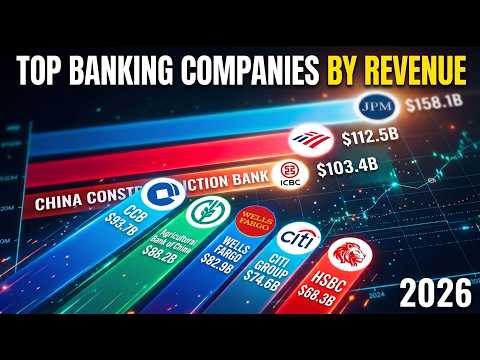
ICBC, China Construction Bank, Agricultural Bank of China, and Bank of China continue to occupy the top four positions in most global rankings by total assets, a pattern already firmly in place in 2023–2025. S&P Global’s 2025 ranking, based largely on balance sheets as of December 31, 2024, shows these four mainland Chinese state‑linked banks at the top, confirming that their scale advantage has persisted into 2026.
Below them, the top 10 is rounded out by a mix of Japanese, U.S. and European giants such as Mitsubishi UFJ Financial Group (MUFG), JPMorgan Chase, HSBC, BNP Paribas and others, depending on whether the specific ranking is based purely on assets or adjusted for mergers and acquisitions (M&A). By assets, Chinese banks dominate; by market value (market capitalization), U.S. banks like JPMorgan Chase still often lead, underlining how “largest” can differ depending on the metric used.
ICBC’s Scale and Role
ICBC remains the world’s largest bank by total assets, with Statista putting its 2023 assets at about 6.3 trillion USD and S&P Global showing that Chinese banks maintained their leading positions through year‑end 2024. Extrapolating modest balance‑sheet growth and currency effects, industry watchers estimate ICBC’s assets in early 2026 to be around 7.5–7.6 trillion USD, which aligns with its continued ranking at the top of The Banker’s “Top 1000 World Banks 2026.”
On the positive side, ICBC is a primary lender to infrastructure, manufacturing, and trade, supporting millions of jobs in China and in Belt and Road partner economies through project finance, working capital, and trade finance lines. It also plays a stabilizing role in China’s domestic financial system, providing liquidity and credit even during periods of property‑sector stress and trade frictions.
However, ICBC’s size also concentrates systemic risk: exposure to China’s struggling real‑estate sector, to highly leveraged local government financing vehicles, and to politically directed lending that may not be fully driven by commercial risk‑return logic. The bank is also closely linked to state policy, so geopolitical tensions, sanctions risk, and shifts in domestic priorities can directly affect how its vast balance sheet is deployed, impacting foreign borrowers and global capital flows.
Chinese Megabanks and “Fragile Rise”
The Banker’s 2026 “Top 1000 World Banks” analysis describes China’s rise as a banking powerhouse as both impressive and fragile. Seven of the world’s ten largest banks by Tier 1 capital are now Chinese, reflecting decades of rapid asset growth, state backing, and domestic savings accumulation.
Positively, these banks have underpinned China’s industrialization, urbanization, and export machine by channeling domestic savings into infrastructure, housing, and corporate investment. They provide large‑scale employment, not only directly in banking but indirectly via credit to construction, energy, logistics, technology, and manufacturing.
Negatively, the same model has led to heavy exposures to a cooling property market and local government debt; profits of China’s largest banks were essentially flat in the latest reporting period as they absorbed rising credit costs and made higher provisions for bad loans. The government has responded by injecting around 500 billion yuan of core Tier 1 capital into the biggest banks, which supports lending but also underscores how dependent the system is on continued state support.
Global Top 10: Who Else Is There?
While exact positions can shift slightly year to year, the 2025 S&P Global ranking combined with 2026 commentary from The Banker and other sources indicates that the top 10 largest banks by assets typically include:
Industrial and Commercial Bank of China (ICBC) – China
China Construction Bank – China
Agricultural Bank of China – China
Bank of China – China
Mitsubishi UFJ Financial Group (MUFG) – Japan
HSBC – UK/Hong Kong
JPMorgan Chase – United States
BNP Paribas – France
One or two additional large Chinese state banks (e.g., Postal Savings Bank of China, Bank of Communications) depending on methodology
Occasionally a large European or Japanese bank entering the lower half of the top 10 depending on M&A adjustments
This top tier controls well over 40 trillion USD in aggregate assets, giving them outsized influence over capital allocation at a global level. Yet they operate within very different regulatory regimes and business models: U.S. and European banks are more market‑driven and diversified into investment banking and asset management, while Chinese megabanks remain more domestically focused and policy‑aligned.
Contribution to Employment and Real‑Economy Sectors
These banks are central employers and financiers for a wide set of sectors. They employ hundreds of thousands of people collectively in front‑office, risk, compliance, technology, operations, and support roles. Beyond direct jobs, their lending decisions shape employment in construction, energy, manufacturing, real estate, agriculture, logistics, technology, and small business.
For example, Australia’s ANZ rose in global rankings after acquiring Suncorp Bank, adding about 3,000 employees and 1.2 million customers, illustrating how consolidation in banking directly affects regional employment and SME financing. Similarly, DBS in Singapore has been expanding through potential acquisitions in Malaysia and Indonesia, reinforcing its status as Southeast Asia’s largest lender and a key provider of trade and infrastructure finance in the region.
The positive side of this scale is that large banks can finance very long‑term and capital‑intensive projects—ports, renewable energy parks, telecom networks, and mass‑transit systems—that smaller lenders simply could not support. On the negative side, when these institutions retrench during crises (tightening credit standards or exiting certain sectors), whole industries and local labor markets can be starved of funding almost overnight.
Innovation, Digitalization, and Fintech
Large banks have used their deep balance sheets to invest heavily in digital banking, cybersecurity, data analytics, and artificial intelligence, particularly in Asia. In China, major banks have millions of monthly active users on mobile banking apps and are among the largest investors in fintech solutions, including AI‑driven risk scoring, digital payments, and automated customer service.
Positively, this has expanded access to financial services, allowing SMEs and individuals in remote areas to access credit, payment services, and savings products via smartphones, reducing friction and transaction costs. It has also improved compliance and fraud detection, as AI tools spot unusual patterns more quickly than manual monitoring.
However, the same digital concentration raises concerns about data privacy, algorithmic bias in lending decisions, and cyber‑security risks that are systemic in nature. If a top‑10 global bank suffers a major cyberattack or technology outage, the consequences for payments, trade finance, and securities markets can cascade across borders in hours.
Systemic Risk and “Too Big to Fail”
The top 10 banks are quintessential “too big to fail” institutions. They are subject to intensive regulation, capital requirements, and stress testing, especially in the U.S. and EU, because their failure could destabilize the entire global financial system. This has led to stronger capital buffers and resolution planning, which is positive from a financial‑stability perspective.
Still, size remains a double‑edged sword. On one hand, large diversified balance sheets allow banks to absorb shocks from one sector or region by offsetting them with profits elsewhere. On the other, the same interconnectedness means that a shock transmitted through these institutions—say, a sudden rise in loan losses from a global recession or from a specific asset class like commercial real estate—can spread rapidly, affecting credit availability for households and firms worldwide.
China’s property downturn is a real‑time example: as real‑estate developers struggle, banks face rising non‑performing loans and must increase reserves, which squeezes profitability and can reduce their appetite to lend to other sectors like SMEs and green infrastructure. Analysts expect higher reserves for loan losses and slower loan growth if global trade volumes decline further under new tariffs and geopolitical tensions.
M&A, Scale, and Market Structure
Recent rankings underscore how mergers and acquisitions are reshaping the banking landscape. S&P Global notes that 15 banks in its 2025 list have pro‑forma figures adjusted for pending or recently completed deals, with examples like Capital One’s acquisition of Discover, Nationwide’s purchase of Virgin Money, and State Street’s deal for Mizuho units in the U.S. and Luxembourg.
These transactions can create efficiencies and broader product suites, often improving service quality and lowering unit costs, which can be positive for large corporate clients and institutional investors. But they also reduce competition in some retail and SME markets, potentially weakening consumer choice and bargaining power, and concentrating market power in a smaller number of very large players.
In Europe, banks such as Société Générale and HSBC are selling assets to streamline their models and improve profitability, which can lead to branch closures and job losses in some regions, even as they strengthen capital ratios and focus on more profitable core markets. This highlights the tension between shareholder returns and local employment/social outcomes.
Social Impact and ESG Contributions
Large global banks have cast themselves as key actors in financing the transition to a low‑carbon economy and achieving the Sustainable Development Goals (SDGs), committing trillions in sustainable finance targets over multi‑year horizons. They support green bonds, renewable‑energy project finance, social housing, and inclusive‑finance initiatives that can have significant positive externalities for communities and workers.
At the same time, NGOs and ESG analysts point out that many of these same banks still provide substantial financing to fossil‑fuel companies, heavy industry, and carbon‑intensive infrastructure, raising questions about “greenwashing” and the pace of real‑world decarbonization. The net societal contribution thus depends on the balance between their sustainable‑finance activities and ongoing support for high‑emission sectors, as well as on how they treat vulnerable customers (for example, in debt collections, fee structures, and small‑business lending).
Policy, Tariffs, and Macroeconomic Headwinds
The 2025–2026 period has been marked by new tariffs and trade tensions, including a 10% baseline duty announced by President Donald Trump with higher rates for select countries, which economists warn could weigh on world trade volumes and, by extension, on banks’ profits and loan growth. Oxford Economics and bank analysts cited by S&P Global expect that higher prices and weaker trade could dampen consumer spending, slow corporate investment, and necessitate higher reserves for loan losses as recession risks rise.
For workers and real‑economy sectors, this environment means more cautious lending, stricter credit conditions, and potential delays or cancellations of major projects that depend on bank finance. For the largest banks, it underscores the importance of strong capital, diversified income streams, and credible risk management in sustaining their real contribution to global growth and employment.
Balanced Critical View for 2026
In 2026, the top 10 largest banks in the world—led by ICBC—remain indispensable to global finance, trade, and development, yet they embody significant contradictions. Positively, they mobilize savings at a massive scale, finance critical infrastructure and business growth, provide millions of jobs directly and indirectly, and invest heavily in technology that can broaden access to financial services.
Negatively, their overwhelming size concentrates economic and political power, magnifies systemic risk, and can weaken competition and bargaining power for ordinary consumers and small firms, especially when consolidation reduces the number of local banking options. Their real value to society ultimately depends on how effectively regulators, shareholders, and the banks themselves balance profitability and stability with long‑term social goals: resilient employment, sustainable development, financial inclusion, and responsible risk‑taking across all sectors of the economy.