Largest Banks in the World 2026: ICBC, JPMorgan & The Global Power List
In 2026, the largest banks in the world by total assets are led by China’s state‑backed giants, with ICBC at the top, while JPMorgan Chase stands out as the most powerful Western bank and the world’s most valuable bank by market capitalization. Together, the top 50 banks hold over 101 trillion USD in assets, concentrating financial power in a relatively small group of institutions that strongly influence jobs, investment, and economic stability worldwide.
The 2026 Global Power List
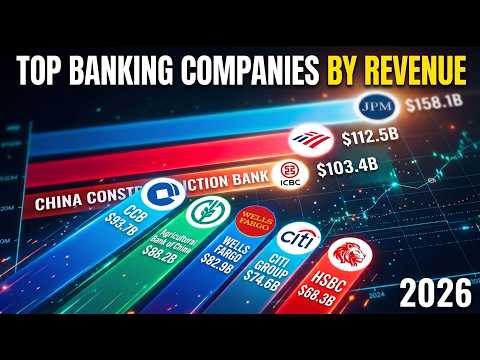
Based on 2026 rankings compiled from CompaniesMarketCap data and aggregated by S&P Global, LinkedIn banking analyses, and visualization platforms, the core global power list by total assets is remarkably consistent. The top names and their approximate asset bases are:
Industrial & Commercial Bank of China (ICBC) – about 7.3–7.6 trillion USD in assets, still the world’s largest bank and the clearest symbol of China’s financial scale.
Agricultural Bank of China (ABC) – around 6.8–7.0 trillion USD, driven by extensive agricultural, rural, and infrastructure lending in China’s vast domestic market.
China Construction Bank (CCB) – roughly 6.2–6.5 trillion USD, a key financier of China’s infrastructure and property sectors.
Bank of China (BOC) – about 5.3–5.5 trillion USD, the most internationally oriented of China’s “Big Four,” with a strong footprint in global trade finance and cross‑border lending.
JPMorgan Chase – around 4.4–4.6 trillion USD in assets, the largest non‑Chinese bank and often ranked #1 globally by overall corporate strength and market value in Forbes’ Global 2000.
Bank of America – roughly 3.4 trillion USD in assets, a U.S. powerhouse in retail, corporate, and investment banking.
BNP Paribas – about 3.3 trillion USD, Europe’s largest bank by assets and a major global corporate and investment bank.
HSBC – around 3.2 trillion USD, a UK‑headquartered but Asia‑focused bank, currently streamlining its footprint to concentrate on more profitable markets.
Crédit Agricole – approximately 2.8–3.2 trillion USD, a French cooperative‑rooted giant with strong retail and asset‑management arms.
Mitsubishi UFJ Financial Group (MUFG) or Postal Savings Bank of China – each close to 2.7 trillion USD in assets, rounding out the “trillion‑dollar club” and underscoring the continued relevance of Japan and second‑tier Chinese banks.
Visual Capitalist and banking commentators highlight that the four largest banks—all Chinese state‑owned lenders—hold about 25.5 trillion USD in assets, roughly a quarter of the 101.6 trillion USD managed by the top 50 banks worldwide. Asia now holds nearly half of total assets in the top‑50 list, driven by 13 Chinese banks, while Europe leads by number of institutions but with smaller average size, and North America balances fewer banks with larger average balance sheets.
ICBC vs. JPMorgan: Scale vs. Market Power
ICBC and JPMorgan Chase illustrate two different dimensions of “largest bank” status in 2026. By sheer assets, ICBC clearly dominates, surpassing 7 trillion USD and maintaining the #1 spot in S&P Global’s 2026 list of the world’s largest banks by assets. It is deeply integrated into China’s state‑directed model, channeling household savings into infrastructure, manufacturing, and property development, and serving as a key vehicle for domestic stabilization policies.
JPMorgan, by contrast, is smaller in assets but stands at the center of the global dollar system. Forbes’ 2026 Global 2000 shows JPMorgan retaining leadership among financial firms thanks to record profits and AI‑driven growth in capital markets, advisory, and transaction banking, while recent coverage highlights its record second‑quarter 2026 earnings and vast daily payment flows. In practice, JPMorgan’s influence over global bond markets, foreign exchange, and corporate dealmaking means its strategic decisions shape capital access and cost of funds for governments and companies worldwide.
Positively, both ICBC and JPMorgan provide enormous volumes of credit, liquidity, and payment services that keep trade, investment, and everyday commerce functioning. Negatively, their scale makes them deeply “too big to fail”: serious mismanagement or a major shock at either institution would have system‑wide repercussions, putting regulators under pressure to intervene and reinforcing concerns about moral hazard and concentrated financial power.
Employment, Sectors, and Real‑Economy Impact
The largest banks in 2026 collectively employ hundreds of thousands of workers and indirectly support millions more jobs across construction, manufacturing, energy, logistics, technology, and services. Their credit decisions shape whether factories expand, real‑estate projects proceed, renewable‑energy parks are built, and small and medium‑sized enterprises (SMEs) can hire and grow.
Positive real‑economy contributions include:
Infrastructure and urbanization finance: Chinese giants such as ICBC, ABC, CCB, and BOC have financed highways, rail networks, ports, and urban development that underpin China’s industrialization and export capacity, while Japanese and European banks like MUFG and BNP Paribas have funded infrastructure and project finance across Asia, Europe, and the Middle East.
SME and trade finance: U.S. and European leaders like JPMorgan, Bank of America, HSBC, and Crédit Agricole are core providers of trade finance, supply‑chain finance, and working‑capital lines that support exporters, manufacturers, and service firms in multiple regions.
Financial‑services employment: These banks are major employers of high‑skilled labor in risk management, compliance, technology, data science, and front‑office roles, offering career paths that influence wage levels and human‑capital development in financial centers from New York to Shanghai and Paris.
However, the same institutions can also harm local economies and workers:
Credit tightening in downturns: When property cycles turn or recession risk increases, big banks often tighten lending standards and reduce exposure to riskier borrowers, which can lead to layoffs, bankruptcies, and shelved projects in vulnerable sectors such as construction, small retail, and export‑oriented manufacturing.
Consolidation and branch closures: As digital banking expands and cost‑cutting accelerates, large banks—especially in Europe and North America—are closing branches, merging entities, and automating services, which can reduce local employment and limit physical access to banking services, particularly in rural and low‑income areas.
Crisis transmission: Because top‑tier banks are highly interconnected via interbank markets, derivatives, and cross‑border exposures, stress in one region or asset class (for example, Chinese property or U.S. commercial real estate) can quickly transmit to others, affecting global credit conditions and investment plans.
Chinese Dominance and Its Fragilities
The Banker’s 2026 “Top 1000 World Banks” describes China’s rise as both dominant and fragile. Chinese institutions occupy the top positions by assets and represent seven of the world’s top ten banks by Tier 1 capital, but their profitability is under pressure from slowing growth, property‑sector stress, and the need for higher provisions against bad loans.
On the positive side, China’s banking system has been instrumental in lifting hundreds of millions out of poverty by financing infrastructure, industrial clusters, and housing on a massive scale. The big state‑owned banks have also been central to cross‑border lending and project finance in developing countries, especially through Belt and Road corridors, helping to fund ports, power plants, and transport networks that can boost long‑term growth and employment abroad.
On the negative side, high exposure to real‑estate developers, local government financing vehicles, and heavy industry raises the risk of asset‑quality deterioration if growth slows further or policy priorities shift. Analysts note that some recent capital strengthening has come from government injections rather than organic profits, underlining how closely these banks are tied to state support and how vulnerable they may be to policy mistakes or prolonged stagnation.
U.S. and European Banks: Profitability, Innovation, and ESG
Although they rank below the Chinese Big Four by assets, U.S. and European banks remain leaders in profitability, innovation, and capital‑markets influence. JPMorgan, Bank of America, and Citigroup dominate in global investment banking, trading, and transaction services, while European institutions like BNP Paribas, HSBC, and Deutsche Bank are systemically important in euro and sterling markets.
From a societal and ESG perspective, many of these banks have adopted large sustainable‑finance targets, committing trillions of dollars in green, social, and transition finance over multi‑year periods. They fund renewable‑energy projects, low‑carbon infrastructure, social housing, and inclusive‑finance programs that aim to broaden access to credit for underserved communities and small businesses.
Yet ESG critics point out that many of the same institutions remain major financiers of fossil‑fuel firms and carbon‑intensive industries, creating a credibility gap between marketing claims and actual portfolio composition. The real positive impact depends on how quickly these banks rebalance away from high‑emission activities while supporting workers and communities affected by the transition, rather than simply shifting reputational risk without changing underlying credit flows.
Digital Transformation and Data Power
By 2026, the largest global banks have invested heavily in digital banking, cloud infrastructure, and artificial intelligence to improve efficiency and manage complexity at scale. JPMorgan and Bank of America have publicly emphasized AI‑driven automation in trading, fraud detection, and customer service, while Chinese giants combine their banking platforms with broader digital ecosystems, leveraging partnerships and competition with fintech and big‑tech players.
Positively, these investments lower transaction costs, reduce error rates, accelerate credit decisioning, and expand access to services via smartphones, which is especially valuable in emerging markets and remote regions. They also create new high‑skill roles in data science, cybersecurity, and digital product management.
Negatively, concentrating financial and behavioral data in a small group of massive institutions raises serious concerns about privacy, surveillance, and algorithmic bias in credit and pricing decisions. A major cyberattack or technology failure at any of the top‑tier banks could disrupt payments, securities settlement, and trade finance across borders, highlighting the systemic importance of robust cybersecurity and operational resilience.
Systemic Risk, Regulation, and Social Trade‑offs
All of the banks on the 2026 global power list are tightly regulated as systemically important institutions, facing higher capital requirements, liquidity rules, and rigorous stress testing from national and international regulators. This framework, strengthened after the 2008 crisis, has improved resilience by forcing banks to hold more loss‑absorbing capital and by introducing resolution planning to handle potential failures without uncontrolled contagion.
The positive side is greater systemic stability and a reduced probability of taxpayer‑funded bailouts, which protects the real economy from the worst fallout of bank crises. The negative side is that “too big to fail” expectations may persist in markets, potentially encouraging risk‑taking by institutions perceived as indispensable and making it harder for smaller competitors and new digital entrants to challenge incumbents.
Ultimately, the largest banks in the world in 2026—led by ICBC and JPMorgan—sit at the core of global capitalism. Their real value to society depends on how they balance profitability and shareholder returns with stable employment, fair treatment of customers, credible ESG and climate action, and a genuine commitment to financing productive, inclusive, and sustainable economic growth across all regions and sectors.