World’s Biggest Banks by Assets: Chinese Giants Dominate 2026 Rankings
In 2026, the world’s biggest banks by total assets are overwhelmingly led by Chinese state‑backed “megabanks,” which occupy the top four positions and hold an unprecedented share of global banking assets. This concentration gives China enormous balance‑sheet power in the global financial system while leaving profitability, innovation, and market influence in many segments still strongly contested by U.S., European, and Japanese rivals.
The 2026 Asset Leaders
By 2026, multiple independent rankings based on CompaniesMarketCap, S&P Global Market Intelligence, and related data converge on a similar top‑10 list by total assets. The leading banks and their approximate asset sizes are:
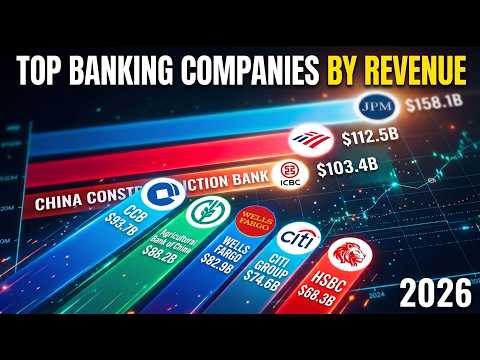
Industrial & Commercial Bank of China (ICBC) – about 7.3 trillion USD in assets, retaining its position as the world’s largest bank and the clearest symbol of China’s banking scale.
Agricultural Bank of China (ABC) – roughly 6.7–6.8 trillion USD in assets, climbing into the #2 spot on the back of extensive rural, agricultural, and infrastructure lending.
China Construction Bank (CCB) – around 6.2 trillion USD in assets, acting as a backbone of China’s infrastructure and property‑related finance.
Bank of China (BOC) – around 5.3 trillion USD in assets, the most internationally oriented of the “Big Four,” with a strong global trade‑finance and cross‑border presence.
JPMorgan Chase – approximately 4.4–4.6 trillion USD in assets, the largest non‑Chinese bank and still often the world’s most valuable by market capitalization, reflecting strong profitability and capital‑markets strength.
Bank of America – roughly 3.4 trillion USD in assets, a dominant U.S. consumer and corporate bank with major investment‑banking activities.
BNP Paribas – about 3.3 trillion USD in assets, Europe’s largest bank and a key player in global corporate and investment banking.
HSBC – around 3.2 trillion USD in assets, a UK‑headquartered but Asia‑centric bank that has been refocusing on core markets while exiting less profitable geographies.
Crédit Agricole – close to 2.8 trillion USD in assets, another French giant with strong retail, cooperative banking, and asset‑management arms.
Mitsubishi UFJ Financial Group (MUFG) – roughly 2.7 trillion USD in assets, Japan’s largest bank and an important global provider of wholesale funding and project finance.
Taken together, the top 50 banks worldwide hold about 101.6 trillion USD in assets, and the top four Chinese banks alone account for roughly 25.5 trillion USD—about a quarter of that total.
Chinese Dominance Explained
China’s megabanks dominate by size because they sit at the center of a vast, state‑oriented financial system that channels high domestic savings into investment, infrastructure, and property. The Banker’s 2026 “Top 1000 World Banks” notes that Chinese banks now represent seven of the world’s ten largest institutions by Tier 1 capital, reflecting both organic growth and ongoing state capital injections to support balance‑sheet strength.
Positively, this dominance has allowed China to finance highways, ports, railways, energy systems, and urban development on a scale unmatched by most other countries, providing employment to millions in construction, engineering, logistics, and upstream industries such as steel and cement. Chinese banks also play a central role in cross‑border projects under initiatives like the Belt and Road, expanding infrastructure and trade links across Asia, Africa, and parts of Europe, and thus shaping economic opportunities in emerging markets.
Negatively, the same model has produced high exposure to a slowing property sector, indebted local governments, and politically driven lending that may not always be commercially sound. Much of the recent rise in Chinese banks’ capital has come from explicit state support rather than purely from retained earnings, highlighting vulnerabilities in asset quality and wider macroeconomic challenges in the world’s second‑largest economy.
U.S. and European Banks: Smaller Size, High Influence
While Chinese banks dominate by total assets, U.S. banks like JPMorgan Chase, Bank of America, and Citigroup remain extremely influential because they lead in market capitalization, profitability, global capital markets, and the infrastructure of the U.S. dollar–based financial system. Forbes’ 2026 Global 2000 shows JPMorgan retaining a top position among financial firms thanks to AI‑driven dealmaking, trading, and capital raising, underlining that “bigger by assets” is not the same as “stronger” or “more profitable.”
European banks, such as BNP Paribas, Crédit Agricole, HSBC, Santander, and Deutsche Bank, appear frequently in the top‑50 and top‑100 lists but are more fragmented across countries and regulatory regimes. Their contribution is substantial in corporate lending, trade finance, and wealth management, particularly across Europe, Africa, and parts of Asia, yet they face structural pressures from low growth, competition, and the need for ongoing restructuring and digital investment.
From a societal and labor‑market perspective, these banks act as major employers and as key financiers of export industries, automotive manufacturing, energy companies, and small and medium‑sized enterprises (SMEs), especially in Europe’s industrial heartlands. At the same time, their episodes of misconduct (e.g., past mis‑selling scandals, money‑laundering failures, and aggressive cost‑cutting) have often harmed public trust and led to significant regulatory fines and compliance overhauls.
Contribution to Jobs and Real‑Economy Sectors
The world’s biggest banks move credit, deposits, and liquidity at massive scale, shaping employment and growth across multiple sectors. The top 50 alone manage over 101 trillion USD in assets and serve hundreds of millions of customers, from large multinationals to small family businesses.
Positive contributions include:
Financing infrastructure: Chinese, Japanese, European, and U.S. banks fund roads, power plants, renewable energy parks, data centers, and ports, creating construction jobs and long‑term productivity gains.
Supporting SMEs and local business: Retail and commercial banking arms provide working capital, equipment loans, and trade‑finance lines that sustain local employment in manufacturing, agriculture, logistics, and services.
Enabling housing and urbanization: Large mortgage and property‑development lending portfolios have underpinned the expansion of cities, housing stock, and related construction supply chains, particularly in China and quickly urbanizing economies.
But there are also negative and ambiguous aspects:
Cyclical credit tightening: When big banks pull back during downturns—tightening lending standards or exiting certain segments—SMEs and lower‑income households are often the first to feel the squeeze in the form of reduced credit and higher borrowing costs.
Consolidation and branch closures: Efficiency‑driven mergers and digitalization efforts, especially in Europe and North America, tend to reduce physical branches and local staff, which can hurt employment and financial inclusion in rural or lower‑income areas.
Crisis transmission: Because these institutions are so interconnected, problems in one asset class (for example, commercial real estate or emerging‑market sovereign debt) can quickly propagate through the system, affecting jobs and investment far beyond the original problem sector.
Systemic Risk and “Too Big to Fail”
Chinese, U.S., European, and Japanese giants at the top of the rankings are all considered systemically important banks (SIBs), meaning their distress could threaten the broader financial system and real economy. Regulators respond with higher capital requirements, stress tests, and resolution plans, which have made the system more resilient than before the 2008 crisis.
Positively, this framework forces big banks to hold more loss‑absorbing capital and to plan for potential failures, reducing the likelihood of taxpayer‑funded bailouts and chaotic collapses. It also encourages better risk management practices and more conservative funding structures, which help protect depositors and corporate clients.
Negatively, “too big to fail” status can create moral hazard: markets may assume that governments will not allow these institutions to fail outright, potentially encouraging excessive risk‑taking and aggressive expansion. In addition, the compliance and regulatory overhead required for SIBs can entrench incumbents by raising barriers to entry for smaller competitors and new digital players, potentially reducing competition and innovation in the long run.
Digitalization, Fintech, and Data Power
By 2026, the biggest banks have invested heavily in digital platforms, artificial intelligence, cloud infrastructure, and cybersecurity to manage their scale and remain competitive. Chinese banks in particular have rolled out advanced mobile apps and integrated digital ecosystems, often in partnership with or parallel to fintech giants and super‑apps, building vast data sets on consumer behavior and creditworthiness.
This digital shift has clear positives: it improves efficiency, lowers transaction costs, enhances fraud detection, and broadens access to financial services by reaching customers in remote or underserved regions via smartphones. For workers, it creates high‑skilled jobs in data science, cybersecurity, software engineering, and digital product design, even as some traditional branch roles shrink.
On the negative side, massive data concentration raises legitimate concerns about privacy, surveillance, and algorithmic bias in credit decisions. A technological outage or cyberattack at any of the top‑tier banks could disrupt payments, markets, and trade flows across multiple countries in a matter of hours, underlining the systemic importance of cybersecurity and operational resilience.
ESG, Climate Finance, and Social Responsibility
The world’s biggest banks have increasingly positioned themselves as key players in environmental, social, and governance (ESG) finance, setting multi‑trillion‑dollar targets for sustainable lending and investment. They provide green bonds, transition financing for energy companies, and funding for renewable projects, social housing, and inclusive‑finance programs, which can deliver real benefits in terms of emissions reduction and social development.
However, many of the same institutions still maintain sizable exposure to fossil fuels and other high‑emission industries, leading to accusations of “greenwashing” when marketing claims outpace the pace of portfolio adjustment. The true social contribution of these banks thus depends not only on how much “green” or social finance they originate but also on how quickly and credibly they shift their core balance sheets away from activities that lock in long‑term climate and social risks.
Geopolitics, Trade Tensions, and Future Outlook
The 2026 rankings emerge against a backdrop of heightened geopolitical tensions, new tariff regimes, and evolving industrial policies in the U.S., China, and Europe. Analysts note that tariffs and economic fragmentation can dampen trade volumes and cross‑border investment, potentially slowing loan growth and pressuring profitability at the very institutions that dominate the rankings.
Chinese banks face the dual challenge of supporting domestic stabilization—especially around property and local government debt—while navigating overseas scrutiny and, in some cases, sanctions or investment restrictions. U.S. and European banks must balance strong capital‑markets and advisory revenues with cyclical credit risk, digital disruption, and increasingly complex regulatory expectations.
Overall, Chinese giants clearly dominate the 2026 league tables by assets, but the real contest is about quality of earnings, risk management, innovation, and social legitimacy. For workers, companies, and societies, the crucial question is not just which banks are biggest—but which ones deploy their enormous balance sheets in ways that support resilient employment, sustainable development, and a more inclusive global economy.