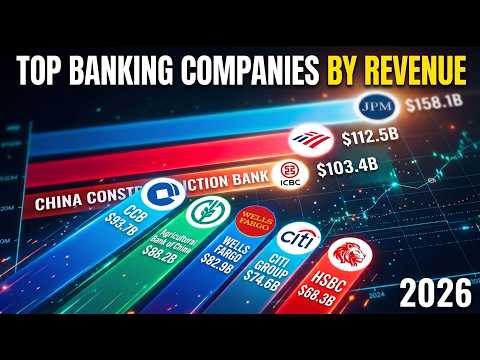
In 2026, the world’s largest banks by total assets are still led by China’s state‑backed giants, with Industrial and Commercial Bank of China (ICBC) topping the global list at roughly 7.6 trillion USD in assets. Behind ICBC, three other Chinese megabanks and a select group of U.S. and European institutions form an elite group that collectively concentrates tens of trillions of dollars in assets and enormous influence over global credit, trade, jobs, and financial stability.
The 2026 Ranking: ICBC and the Trillion‑Dollar Elite
Most 2026 rankings that rely on the latest consolidated balance‑sheet data converge on a similar top tier of banks by total assets. A widely cited 2026 list of the 10 largest banks by total assets shows:
ICBC – about 7.65 trillion USD in assets, confirming it as the single largest bank in the world.
Agricultural Bank of China – roughly 6.97 trillion USD, benefiting from its vast rural and agricultural footprint plus infrastructure lending.
China Construction Bank – around 6.52 trillion USD, heavily exposed to infrastructure and property finance in China’s urban centers.
Bank of China – approximately 5.48 trillion USD, combining a strong domestic base with a broad international network in trade finance and cross‑border banking.
JPMorgan Chase (U.S.) – about 4.42 trillion USD in assets, the largest Western bank by balance sheet and often the global leader by market capitalization and profit.
Bank of America (U.S.) – roughly 3.41 trillion USD, blending retail, wealth management, and investment banking at massive scale.
BNP Paribas (France) – around 3.28 trillion USD, the biggest bank in the euro area by assets.
HSBC (UK) – about 3.21 trillion USD, a UK‑domiciled but Asia‑centric institution that is refocusing on core Asian markets.
Crédit Agricole (France) – roughly 3.15 trillion USD, a cooperative‑rooted French giant with extensive retail and corporate franchises.
Postal Savings Bank of China – about 2.67 trillion USD, underlining how even China’s “second‑tier” big banks now operate at a truly global scale.
Taken together, just these 10 banks manage well over 40 trillion USD, and estimates suggest that the top 50 banks worldwide hold about 101.6 trillion USD in assets—almost as much as the entire global government‑debt stock. Six of the world’s top 18 banks by assets are headquartered in China, three in Japan, four in the United States, and the rest across major European markets, reflecting a clear East‑West concentration of financial power.
ICBC at $7.6 Trillion: Scale, Strength, and Exposure
ICBC’s estimated 7.6 trillion USD in assets in 2026 makes it not just the largest bank in the world, but the first to approach this scale in modern history. Its balance sheet includes massive portfolios of corporate loans, infrastructure finance, mortgages, and holdings of Chinese government and policy‑bank securities, making it a central channel through which China transforms domestic savings into investment.
On the positive side, ICBC has been a key financier of:
National infrastructure – highways, rail, ports, utilities, and digital networks that underpin China’s growth and employment.
Corporate expansion – lending to manufacturers, exporters, and service providers that employ millions domestically and abroad.
International projects – participation in Belt and Road and other cross‑border financing that supports infrastructure and trade in emerging markets.
Yet ICBC’s size also magnifies structural risks:
Property‑sector exposure – large loan books to developers and mortgage borrowers amid a multi‑year property slowdown increase credit‑risk concerns.
Policy dependence – as a state‑controlled bank, ICBC is expected to support policy goals even when commercial returns are uncertain, creating potential tension between financial stability and political objectives.
Systemic importance – any serious stress at ICBC would immediately transmit into China’s financial system and global markets, given its scale and interconnectedness.
The net effect is a bank that is both a cornerstone of China’s growth story and a focal point for debates about the sustainability of a state‑directed, bank‑heavy development model.
Beyond China: JPMorgan and the Western Heavyweights
While ICBC leads on assets, U.S. and some European banks lead on profitability, market value, and capital‑markets influence. JPMorgan Chase is a prime example: with around 4.4 trillion USD in assets and a market capitalization near 920 billion USD in early 2026, it is widely regarded as the world’s most valuable bank.
Recent reporting highlights JPMorgan’s record Q2 2026 profit, driven by strong revenue growth across investment banking, trading, payments, and consumer finance. Its importance goes far beyond its balance‑sheet size:
It is a central player in U.S. Treasuries and global bond markets, influencing borrowing costs for governments and corporations worldwide.
It operates huge global payments and custody networks, moving trillions of dollars in daily flows and safeguarding client assets.
It leads in advisory and capital‑raising roles, guiding M&A, IPOs, and restructurings that reshape industries and labor markets.
Positively, this makes JPMorgan a powerful enabler of investment, innovation, and liquidity. Negatively, it concentrates market power and systemic risk in a single institution whose internal decisions and risk models have global implications.
Bank of America, BNP Paribas, HSBC, and Crédit Agricole play similar—if somewhat more regional—roles as pillars of credit and capital markets in North America and Europe. They provide funding to SMEs, exporters, and households, support bond markets and derivatives trading, and are major employers across finance, technology, compliance, and operations. At the same time, they must navigate low European growth, regulatory pressure, restructuring costs, and the reputational legacy of past scandals and crises.
Real‑Economy Contribution: Jobs, Infrastructure, and Trade
The world’s largest banks are often criticized as abstract “too big to fail” entities, but their influence is very concrete when viewed through jobs and sectors. The top 10 and top 50 banks together support millions of direct and indirect jobs and finance a broad swath of real‑economy activity.
Positive contributions include:
Infrastructure and energy: Financing large‑scale transport networks, power generation (including renewables), and digital infrastructure that improves productivity and generates long‑term employment in engineering, construction, and operations.
Housing and urban development: Providing mortgages and developer finance that shape urbanization patterns, housing supply, and construction‑sector jobs, especially in China, Europe, and the U.S.
Trade and supply chains: Offering trade‑finance instruments, FX services, and working‑capital lines that keep global supply chains functioning for manufacturers, agribusiness, and logistics firms.
However, there are also negative or ambiguous effects:
Pro‑cyclical lending: In booms, abundant credit can fuel asset bubbles (especially real estate); in downturns, rapid credit tightening by large banks can deepen recessions and accelerate layoffs.
Unequal access: Large corporates enjoy deep relationships and favorable terms, while micro‑businesses and low‑income households often face higher costs or exclusion, even as banks report record profits.
Social and environmental externalities: Projects and sectors financed by these banks can cause pollution, land disputes, or social displacement if not governed by strong ESG standards, pushing hidden costs onto communities and future generations.
Systemic Risk, Regulation, and Market vs. State Tensions
The concentration of assets in a handful of global banks inevitably raises systemic‑risk concerns. International bodies and central banks classify many of these institutions as global systemically important banks (G‑SIBs) and impose higher capital buffers, stricter liquidity rules, and detailed resolution planning.
Positives of this framework:
Greater resilience – higher capital and liquidity reduce the probability of outright failure and make banks more shock‑resistant.
Better transparency – stress tests and disclosures help markets and regulators see where vulnerabilities lie.
Negatives and tensions:
Moral hazard – markets may still assume that the largest banks will be supported in a crisis, encouraging risk‑taking.
Barriers to competition – compliance costs can entrench incumbents and disadvantage smaller, more innovative competitors and community banks.
State vs. market dynamics – in China, large banks like ICBC sit at the intersection of state planning and market finance, creating structural tension between political objectives and risk‑adjusted returns.
Analysts and think tanks have long noted that China’s financial system operates under a dual logic: using banks as instruments of industrial policy and social stability while trying to introduce more market discipline and competition. This hybrid model has supported rapid development but also built up hidden risks in credit allocation, particularly in property and local government sectors.
Market Value vs. Asset Size: Two Different Leaderboards
It is important for readers and SEO‑oriented content to recognize that “largest” can mean different things. Rankings based on total assets have ICBC at #1 with roughly 7.6 trillion USD and Chinese banks dominating the top of the list. Rankings based on market capitalization, however, tell a different story:
JPMorgan Chase is the largest bank in the world by market value, with a market cap of about 920 billion USD in early 2026.
Bank of America, Agricultural Bank of China, ICBC, and China Construction Bank round out the top five by market value, with U.S. and Chinese banks jointly occupying most of the top spots.
The top 50 banks by market capitalization collectively have a market value of over 8.6 trillion USD, underscoring how investor confidence, profitability, and perceived risk shape a very different “power ranking” than assets alone.
This contrast highlights a crucial analytical point: asset size reflects scale and systemic footprint, while market value reflects profitability, risk, and investor expectations. A bank can be huge by assets yet underperform in market valuation if its returns are low or its risks are perceived as high.
ESG, Digitalization, and the Future Role of the Giants
By 2026, the world’s largest banks increasingly present themselves as agents of sustainable finance and digital transformation. Many have multi‑trillion‑dollar sustainable‑finance commitments covering green bonds, renewable projects, social housing, and inclusive‑finance schemes. They also invest heavily in AI, cloud computing, and cybersecurity to modernize operations and create new digital services.
Positive potential:
Climate and transition finance – large banks can redirect capital at scale toward cleaner energy, resilient infrastructure, and low‑carbon technologies.
Inclusion via digital – mobile and digital banking can reduce geographic and income‑based barriers to basic financial services.
Risks and criticisms:
Greenwashing – some institutions continue to finance fossil fuels and high‑emission activities at scale while promoting ESG labels, inviting scrutiny from civil society and regulators.
Data and AI risks – centralized data and algorithm‑driven decisions can entrench biases, threaten privacy, and amplify systemic vulnerabilities in the event of cyberattacks.
Critical Balance: Power, Responsibility, and Social Progress
The 2026 ranking of the world’s largest banks—with ICBC at roughly 7.6 trillion USD in assets at the top—tells a story of immense concentration of financial power. Chinese megabanks dominate by scale, U.S. institutions like JPMorgan lead by market value and profitability, and European and Japanese banks continue to provide essential regional stability and funding.
From a positive perspective, this concentrated system can efficiently mobilize savings into large‑scale projects, stabilize markets, and finance innovation and employment across sectors and borders. From a critical perspective, it heightens systemic risk, entrenches “too big to fail,” and can leave smaller firms, low‑income households, and vulnerable countries dependent on a small set of decision‑makers whose priorities may not always align with long‑term social progress.
For policymakers, businesses, and society, the key question is not just which bank tops the list, but how these global giants use their balance sheets: whether they double down on short‑term, high‑risk returns, or actively support a more inclusive, sustainable, and resilient global economy that spreads the benefits of finance beyond the narrow circle of shareholders and wholesale clients.