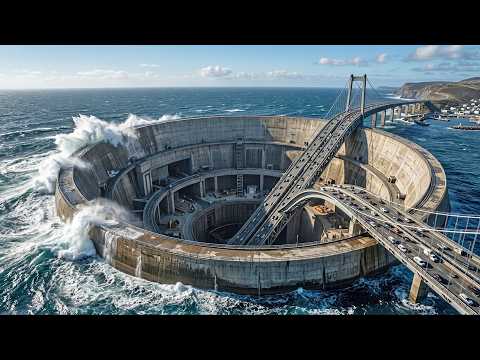
Epic Most Expensive Technologies on Earth: Billion-Dollar Innovations Shaping the Future
The most expensive technologies on Earth are not just impressive machines; they are long-term investments in science, industry, and civilization-level progress. In 2026, the clearest examples include the International Space Station, ITER, EUV lithography systems, and frontier AI infrastructure, each carrying extraordinary costs but also the potential to reshape energy, computing, manufacturing, and exploration.
Why these technologies are so costly
These systems are expensive because they sit at the extreme edge of engineering. They require custom materials, precision manufacturing, advanced software, global supply chains, and years or decades of testing, integration, and maintenance.
The headline price is only part of the story. The real cost also includes operations, upgrades, workforce training, logistics, and the political or corporate coordination needed to keep such systems functioning over time.
International Space Station
The International Space Station remains one of the most expensive technologies ever built, and its value extends far beyond its construction budget. It has served as a permanent microgravity laboratory for research in human health, materials science, Earth observation, and space operations.
Its positive impact is substantial. The ISS has generated scientific data, helped train generations of astronauts and engineers, and demonstrated what international collaboration can achieve in a highly complex environment. Its negative side is equally important: it is expensive to maintain, depends on constant logistics, and is becoming harder to justify as the station ages and future orbital platforms emerge.
ITER fusion reactor
ITER is one of the boldest technological bets ever made. Built to prove the scientific viability of fusion energy, it represents a possible path toward cleaner, high-density power with major implications for energy security and climate policy.
The positive scenario is transformative. If fusion can be demonstrated successfully and scaled later, it could support decarbonization, industrial electrification, and a new global energy economy. The negative scenario is also real: ITER has faced repeated delays and rising costs, and critics argue that it may never deliver practical grid power despite decades of funding.
EUV lithography systems
EUV lithography machines are among the most expensive and strategically important industrial technologies in the world. They are essential for producing the most advanced semiconductors, which power smartphones, data centers, supercomputers, defense systems, and AI hardware.
Their contribution to society is enormous. EUV technology supports the chip ecosystem that drives digital growth, productivity, and technological miniaturization. The downside is concentration: the systems are extremely costly, controlled by a very small number of suppliers, and tied to geopolitical tensions, export rules, and supply-chain vulnerability.
Frontier AI infrastructure
Advanced AI systems now belong in the same discussion because the infrastructure behind them has become extremely expensive. Training and deploying cutting-edge AI requires massive GPU clusters, power-hungry data centers, high-end networking, cooling systems, and specialized software stacks.
The positive impact is already visible across many sectors. AI is helping with code generation, medical analysis, logistics, cybersecurity, customer service, and scientific discovery. But the negative side is growing too: the cost of entry is rising, energy use is significant, and the benefits are increasingly concentrated among large firms and institutions with the resources to build these systems.
What they contribute to society
These technologies contribute more than raw performance. They create jobs for engineers, physicists, technicians, software developers, manufacturing specialists, and supply-chain managers. They also support entire industrial ecosystems in aerospace, semiconductors, energy, communications, and computing.
Their broader social value lies in capability expansion. The ISS expands humanity’s space research capacity, ITER keeps open the possibility of a new energy era, EUV lithography enables the next generation of chips, and AI infrastructure accelerates productivity across nearly every sector.
The critical trade-off
The most common criticism is opportunity cost. Every billion spent on these megaprojects is money not spent on healthcare, education, housing, infrastructure, or climate adaptation.
There is also the risk of overpromising. Some projects deliver real progress but fall short of their original vision, which can erode public trust and invite skepticism. That is why transparency, milestones, and realistic expectations are essential.
Final perspective
The most expensive technologies on Earth are expensive because they are trying to do what ordinary systems cannot. Some are already producing major value, some are still proving themselves, and some may ultimately become cautionary tales about the limits of ambition.
What unites them is their power to shape the future. Their true worth is not only in the money spent, but in the new science, industries, and societal capabilities they make possible.