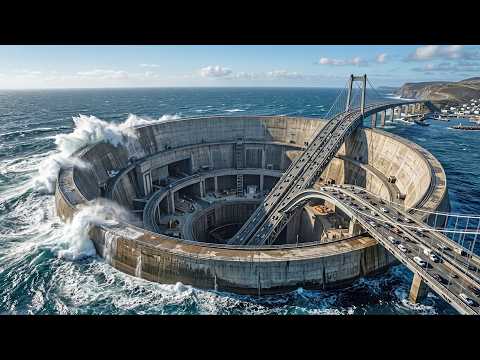
Inside the Most Expensive Machines Ever Created: $20 Billion+ Flagship Technologies and Their Impact
The most expensive machines ever created are not just feats of engineering; they are symbols of how far governments, research institutions, and private industry will go to solve problems at the edge of human capability. From fusion reactors and particle accelerators to space stations and deep-space observatories, these flagship technologies represent enormous financial commitments, but also the possibility of scientific breakthroughs, industrial spin-offs, and long-term social value.
Why these machines cost so much
These machines become extraordinarily expensive because they combine custom design, advanced materials, extreme precision, long development cycles, and complex international coordination. In many cases, the budget reflects not only construction, but also years of testing, redesign, logistics, operations, and maintenance.
That is why the real cost is often larger than the headline number. A machine like a fusion reactor or a space station is not a one-time purchase; it is a decade-spanning commitment to research, infrastructure, and institutional support.
The logic of flagship technologies
High-cost machines are usually built for one of four reasons: to expand scientific knowledge, strengthen national security, improve global connectivity, or create an entirely new industrial frontier. Their value is rarely immediate, and that makes them controversial, but their long-term influence can be massive.
The strongest argument in their favor is that some problems are simply too complex for small-scale solutions. Fusion energy, orbital research, deep-space observation, and advanced particle physics all require machines that are expensive because the questions themselves are expensive to answer.
Fusion reactors and the clean-energy promise
Fusion reactors sit at the center of one of the boldest technological bets in modern history. Their appeal is obvious: if fusion can be made practical and economical, it could offer abundant, low-carbon energy with transformative consequences for power generation, heavy industry, and global decarbonization.
The positive scenario is easy to understand. A working fusion economy could reduce dependence on fossil fuels, improve energy security, and create entirely new sectors around reactor design, plasma engineering, superconducting systems, and advanced materials. That would affect everything from utilities and manufacturing to transport and climate policy.
The negative scenario is just as important. Fusion programs are famously long, costly, and uncertain, and critics argue that they can absorb enormous public money before delivering a product that society can actually use. In that sense, fusion is both a breakthrough opportunity and a test of whether civilization can fund science with patience.
Particle accelerators and fundamental science
Particle accelerators are among the most expensive machines ever built because they push physics, engineering, and computing to their limits. They require ultra-precise magnets, cryogenic systems, detector arrays, and massive collaboration among scientists, universities, and contractors.
Their value to society is real, even if indirect. They deepen our understanding of matter, support advanced software and data analysis, and drive innovations in superconductivity, instrumentation, and medical technologies. They also train highly skilled workers who later move into aerospace, healthcare, energy, and high-performance computing.
Still, the criticism remains valid. To many people, a machine that studies subatomic particles can seem disconnected from daily life. That tension between pure knowledge and practical utility is why accelerators are often admired by scientists and questioned by budget-minded policymakers.
Space stations and orbital infrastructure
Space stations are some of the clearest examples of expensive machines producing visible public value. They function as microgravity laboratories, engineering testbeds, and international diplomatic platforms, while also supporting research that affects medicine, materials science, and Earth observation.
Their contribution to society is broader than many people realize. Space station research has supported work on bone loss, muscle atrophy, fluid behavior, food systems, and remote operations. These findings help not only astronauts, but also patients, engineers, and industries that rely on advanced materials and biomedical knowledge.
But space stations are also costly to keep alive. They require continuous resupply, trained crews, complex maintenance, and long-term political coordination. Their biggest weakness is that their value is spread across many fields, which makes it harder to explain to the public in simple economic terms.
Deep-space observatories and scientific return
Large space observatories are expensive because they must survive extreme conditions while delivering near-perfect precision. Once deployed, they can reshape astronomy by revealing new information about galaxies, planets, and cosmic history.
Their positive impact is especially strong in education, scientific prestige, and technical innovation. Projects like these inspire future scientists and engineers while also advancing optics, thermal control, autonomous systems, and precision deployment methods.
The criticism is that these are prestige-heavy investments. They create enormous intellectual value, but not direct consumer value, which means their success depends on whether societies are willing to fund long-horizon knowledge for its own sake.
Corporate megamachines and private infrastructure
Not all expensive machines are public projects. Private companies now build systems so large and complex that they function like national infrastructure. Satellite networks, giant data centers, AI training systems, and specialized industrial platforms are increasingly shaping global commerce.
The positive case is strong. These machines improve communications, accelerate automation, and help businesses operate at a global scale. They also create new jobs in software, logistics, chip design, systems integration, and network operations.
The downside is concentration. When a single company controls critical infrastructure or massive compute resources, it can shape access, pricing, and power in ways that are difficult to regulate. That makes private megamachines both engines of innovation and sources of structural risk.
What they contribute to work and society
The real contribution of these flagship technologies is not limited to their primary mission. They generate employment, knowledge, supply chains, and technical standards that spread across sectors.
In aerospace, they advance propulsion, guidance, materials, and mission control. In energy, they push the boundaries of clean power and grid resilience. In healthcare, they improve imaging, monitoring, and biomedical research. In digital industries, they accelerate data processing, network capacity, and artificial intelligence. In manufacturing, they raise standards for precision, reliability, and automation.
That is their biggest hidden value: they do not just perform a task. They expand what entire industries are capable of doing next.
The critical trade-off
The criticism of these machines is not trivial. They are expensive, slow, and often difficult to justify when societies face urgent needs like housing, education, public health, and climate adaptation. Some become cautionary tales of overpromising and underdelivering.
But rejecting them outright would also be a mistake. The history of technology shows that some of the most important breakthroughs begin as high-cost experiments with uncertain payoffs. The real challenge is discipline: transparent budgets, realistic milestones, and an honest assessment of whether a machine is delivering durable public benefit.
Final perspective
The most expensive machines ever created are powerful because they sit at the intersection of ambition and consequence. They can drive discovery, create industries, and improve life at scale, but they can also become monuments to excess when execution fails.
Their value depends on more than cost. It depends on whether they produce knowledge, capability, and progress that outlast the machine itself.