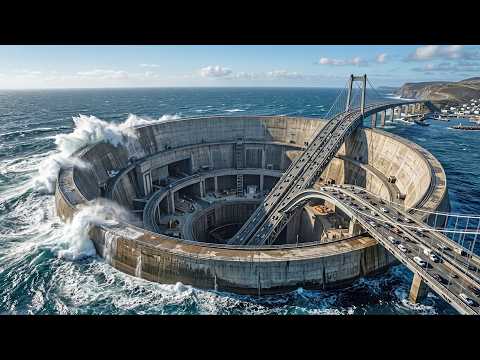
The world’s most expensive technologies are not simply costly machines; they are large-scale bets on discovery, national strategy, and the future of industry. From fusion reactors and particle accelerators to space stations, telescopes, and advanced defense systems, these projects reveal how far governments and companies are willing to go to push the limits of science and engineering.
Why these technologies are so expensive
These projects become expensive for the same reasons they become historic: they are technically extreme, highly specialized, and built to solve problems that ordinary systems cannot. They often require international partnerships, custom materials, precision manufacturing, long development cycles, and decades of maintenance.
Their costs also include failure risk, redesigns, political delays, and supply-chain complexity. In many cases, the final bill is not just the cost of building the machine, but the cost of sustaining ambition across multiple generations of engineers and policymakers.
Fusion reactors: the long bet on clean power
ITER is one of the clearest examples of a technology whose promise is bigger than its current output. The project is designed to demonstrate fusion as a scientifically viable energy source, and recent reporting says it has faced fresh delays and about €5 billion in additional costs, with research operations now expected later than previously planned.
The positive case is compelling. If fusion becomes practical at scale, it could transform electricity generation, reduce dependence on fossil fuels, and strengthen long-term energy security with very low carbon emissions. The negative case is just as important: ITER is not a power plant, it does not produce electricity for the grid, and critics argue that its growing cost and slow timeline make it a symbol of scientific ambition that is difficult to justify in budget terms.
Particle accelerators: expensive science with deep reach
Particle accelerators such as the Large Hadron Collider are among the most expensive scientific instruments ever built. Their cost is high because they require superconducting magnets, cryogenic systems, advanced detectors, and highly specialized international research infrastructure.
The positive value is enormous for basic science. These machines help answer fundamental questions about matter, energy, and the universe, while also driving advances in computing, materials science, and precision engineering. The criticism is that their benefits are often indirect and long-term, which makes them vulnerable to public skepticism when compared with more visible social needs.
Space stations: science, diplomacy, and maintenance cost
The International Space Station remains one of the most expensive human-made technologies ever built, and it is still one of the strongest examples of international technical cooperation. NASA’s ISS benefits publications describe how space station research supports health, Earth observation, disaster response, and innovation on Earth.
Its strengths are obvious: it has produced years of microgravity research, sustained a permanent human presence in orbit, and created new skills across aerospace supply chains. Its weaknesses are also clear: it is expensive to maintain, increasingly dependent on continuous logistics, and tied to aging infrastructure that will eventually need replacement.
Space telescopes: high cost, high discovery
The James Webb Space Telescope sits near the top of any list of expensive scientific technologies, but its value is measured in discovery rather than commercial revenue. It is a model of what long-term public investment can produce when engineering excellence and scientific ambition align.
Its positive impact includes unprecedented views of distant galaxies, planetary atmospheres, and cosmic formation processes. The critical view is that society must accept high cost for knowledge that does not immediately translate into jobs or consumer products, even though the downstream benefits often arrive later in education, computation, optics, and research ecosystems.
Private megaprojects and global connectivity
The rise of private megaprojects has changed the meaning of “expensive technology.” Starlink, for example, is not just a satellite service; it is a global communications infrastructure project that includes satellites, launch systems, user terminals, and network operations.
Its contribution is already visible in remote connectivity, emergency communications, business operations, and rural access. But it also raises major concerns about orbital congestion, corporate control of critical infrastructure, and the broader environmental and regulatory consequences of putting so much hardware into low Earth orbit.
Defense systems and strategic value
Some of the most expensive technologies in the world are defense platforms such as stealth bombers, nuclear submarines, and advanced aircraft carriers. These systems are built for deterrence, survivability, and geopolitical leverage rather than for commercial profit.
Their positive contribution is strategic stability, advanced manufacturing, and the creation of high-skill industrial jobs. Their negative side is the scale of public spending, the secrecy that limits transparency, and the opportunity cost of tying so much budget to a small number of highly specialized systems.
What these projects contribute to society
The real value of expensive technologies is spread across many sectors. They support engineers, scientists, software developers, aerospace contractors, logistics specialists, technicians, and researchers across multiple countries.
In healthcare, space research has supported work on human physiology and disease-related processes. In energy, fusion research keeps open the possibility of a cleaner and more resilient power system. In communications, satellite networks are expanding access to digital infrastructure where terrestrial systems are weak or absent.
These are not just prestige projects. They are training grounds, supply-chain engines, and proof that coordinated human effort can still produce systems too complex for any single company or country to build alone.
The critical trade-off
The central criticism of expensive technologies is opportunity cost. Every billion spent on fusion, space, defense, or particle physics is a billion not spent elsewhere, and that matters when societies face urgent needs in housing, healthcare, energy transition, and education.
Still, a narrow focus on immediate returns can miss the long game. Some of the most important breakthroughs in history began as costly, uncertain projects that looked excessive before they became indispensable. The best policy approach is not to reject ambitious projects, but to demand transparency, measurable milestones, and a realistic understanding of when a project is truly transformative.
Final perspective
Fusion reactors, particle accelerators, space stations, and other megaprojects represent the outer edge of human ambition. Their price tags are enormous, but so is their potential to reshape energy, science, defense, and global connectivity.
The smartest way to judge them is not by hype or skepticism alone, but by whether they create lasting knowledge, skilled work, industrial capability, and meaningful progress for society.