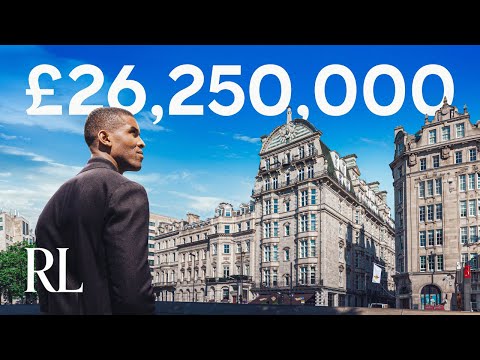
London’s super-prime property market remains one of the most closely watched luxury segments in the world, and recent headline sales have shown that elite demand is still capable of producing extraordinary results. Industry reporting indicates that London’s top residential deals in 2025 collectively exceeded £400 million, with major transactions such as The Holme in Regent’s Park helping define the scale and prestige of the market. At the same time, fresh 2026 data shows a renewed rebound in ultra-prime demand, with sales above £15 million reaching £1.24 billion in the first half of the year, suggesting that confidence at the very top of the market has returned in a selective but meaningful way.
This article examines how London’s super-prime market generates these record-setting figures, where the money is coming from, and why the city continues to attract global capital from the United States, the Middle East, and other major wealth centers. Reports from 2026 show that American and Gulf buyers are playing a particularly strong role, while firms such as Beauchamp Estates, Savills, Coutts, Black Brick, and CBRE continue to shape the market through research, brokerage, and capital insight. The result is a market that is no longer driven only by old non-dom patterns, but increasingly by lifestyle, security, and long-term asset preservation.
There is a compelling positive case for this sector. Super-prime home sales generate work across architecture, construction, interior design, engineering, surveying, law, private banking, luxury retail, and high-end hospitality, creating a broad economic ripple beyond the homes themselves. Major trophy transactions also help preserve landmark homes, support specialist trades, and reinforce London’s position as a global center for finance, design, and real estate expertise.
But the negative side deserves equal attention. Research and public reporting continue to show that ultra-prime housing can intensify inequality, encourage speculative ownership, and contribute to empty or underused homes in some of London’s wealthiest districts. The latest market slowdown in early 2026 also suggests that policy uncertainty, tax pressure, and changing global sentiment can quickly cool demand at the top end, even when headline sales figures remain impressive. That makes the super-prime segment both powerful and fragile: it can stimulate jobs and investment, but it can also deepen the social distance between elite property ownership and the wider housing reality facing most Londoners.
In practical terms, this story is about more than luxury. It is about how a small number of high-value homes can influence employment, capital flows, heritage preservation, and urban inequality at the same time. That balance is what makes London’s super-prime market so important in 2026: it remains a symbol of global wealth, but also a case study in the economic and social consequences of extreme property concentration.