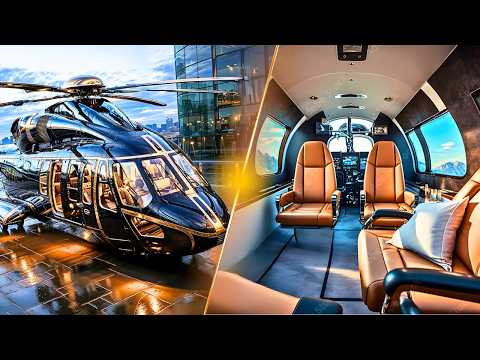
In 2026, the most expensive private aircraft range from 5–30 million‑dollar luxury helicopters to private jets and VIP airliners costing between 75 and more than 600 million dollars. These machines combine extreme price tags with bespoke interiors, advanced avionics, and performance optimized for heads of state, billionaires, and top‑tier corporations.
They also sit at the center of a heated debate: private aviation creates jobs, connectivity, and innovation, yet it is among the most carbon‑intensive and unequal forms of travel in the world.
Ultra-Luxury Helicopters: Prices and Features
Sikorsky S‑92 Executive – $27–30 Million
The Sikorsky S‑92 in VIP configuration is often cited as the most expensive private helicopter currently available, with base prices around 27 million dollars and fully customized versions exceeding 30 million. Designed originally for offshore and search‑and‑rescue operations, the S‑92’s VIP variant offers a spacious cabin with armchair seating, conference layouts, and optional sound‑deadening and advanced entertainment systems.
Positively, the S‑92’s proven safety and performance record makes it a favorite for heads of state and corporate shuttle missions, enabling fast point‑to‑point links in regions where fixed‑wing aircraft cannot land. Negatively, the high operating cost and fuel burn per passenger, especially on short trips, underline the environmental cost of using heavy helicopters primarily for luxury and status.
Leonardo AW609 Tiltrotor – $20–30 Million
The Leonardo AW609 tiltrotor, combining helicopter‑like vertical take‑off with turboprop‑like cruise speeds, is priced between roughly 20 and 30 million dollars in VIP form. It can cruise at around 275 knots and offers ranges of 700–1,000 nautical miles, allowing it to bridge the gap between traditional helicopters and light jets.
Positively, the AW609 demonstrates true innovation in vertical lift, potentially opening new markets for point‑to‑point travel and emergency services without runways. Negatively, its high ticket price and complex certification environment mean that, at least initially, it will largely serve high‑end corporate and government clients rather than broad public mobility needs.
Bell 525 Relentless – ~ $20 Million
The Bell 525 Relentless, priced at about 20 million dollars, is marketed as a “business jet of helicopters,” offering a large, configurable cabin, advanced fly‑by‑wire controls, and high cruise speeds. In VIP trim, it can feature leather club seating, integrated workspaces, and entertainment systems similar to those in high‑end jets.
On the positive side, the Bell 525 brings advanced automation and safety features—like full digital flight controls—to the rotorcraft segment, which can reduce pilot workload and improve safety across both VIP and utility configurations. On the negative side, its positioning as a prestige product reinforces the narrative of vertical flight as a luxury rather than a potential mass‑mobility solution.
Airbus ACH160 & ACH175 – $14–20+ Million
Airbus’s ACH160 and ACH175 sit in the 14–20 million‑dollar range for VIP configurations. The ACH160 offers advanced five‑blade rotors, a quiet, modern cabin, and sophisticated avionics, while the larger ACH175 can be configured as a “flying lounge” with multiple seating zones and high‑end finishes.
These helicopters positively contribute by bringing cutting‑edge rotor technology and cabin comfort to executive and offshore markets, supporting jobs in European aerospace hubs. Negatively, their adoption as lifestyle accessories for the ultra‑rich—rather than as tools for broader mobility—underscores the unequal distribution of vertical access in dense cities and remote regions.
Most Expensive Private Jets in 2026: Headline Prices
Gulfstream G700 / Bombardier Global 7500–8000 – ~$75–80 Million
At the lower edge of “ultra‑expensive,” ultra‑long‑range jets like the Gulfstream G700 and Bombardier Global 7500/8000 list at around 75–80 million dollars before custom interiors. These aircraft offer ranges of over 7,000 nautical miles, Mach 0.90‑class cruise speeds, and cabins divided into four or five zones for work, dining, entertainment, and rest.
Positively, they enable high‑speed, non‑stop travel between major business hubs, helping global firms reduce travel time and improve access to secondary airports. Negatively, their carbon footprint per passenger is many times that of commercial flights, and the rapid growth of this segment is a significant driver of private aviation emissions.
Airbus ACJ TwoTwenty & ACJ319neo – ~$80–110 Million
The Airbus ACJ TwoTwenty, based on the A220, is valued around 80–100 million dollars in VIP form, while the ACJ319neo often comes in around 101–110 million dollars. The TwoTwenty offers roughly 780+ square feet of cabin space, enabling wide lounges, a separate bedroom, and office areas, while the ACJ319neo combines airline‑grade systems with a low‑density, fully customized interior.
These jets positively showcase new concepts focused on space and comfort and help keep European manufacturing and completion centers competitive. However, they also illustrate how efficient airliner platforms are increasingly turned into private lofts rather than mass‑transport assets, raising questions about priorities in a decarbonizing world.
Boeing 747‑430 (Sultan of Brunei) – $320M+
BlackJet and other luxury aviation sources estimate the Sultan of Brunei’s Boeing 747‑430 at over 320 million dollars, with gold‑accented interiors, custom fixtures, and multiple private suites. The aircraft’s cabin is configured more like a palace than a transport asset, with dedicated reception, dining, sleeping, and ceremonial spaces.
Positively, the 747‑430 supports high‑end crafts and acts as a national symbol during state visits. Negatively, it epitomizes concentrated wealth and high‑carbon luxury and is often cited in debates over how resource‑rich states allocate funds between symbolic assets and public goods.
Airbus A340‑300 VIP – ~$400–500M
Custom Airbus A340‑300s in private hands, such as those linked to Alisher Usmanov, are reported in the 400–500 million dollar range once bespoke interiors and systems are factored in. Interiors can include nightclub‑style lounges, large dining rooms, guest suites, and integrated offices, making the aircraft an airborne estate.
On the positive side, such conversions extend the life of long‑haul airframes and support high‑margin completion and MRO work. On the negative side, the A340’s four‑engine design combined with low passenger loads drives high emissions per passenger, making these jets key targets in campaigns against “dirty luxury.”
Boeing 747‑8 VIP & Airbus ACJ350 – ~$317–367M
JetFinder and other 2026 rankings place Boeing 747‑8 VIPs and Airbus ACJ350s in the 317–367 million dollar band. The 747‑8 VIP uses a stretched, updated 747 frame with improved engines, offering long‑range capacity and large multi‑deck cabins, while the ACJ350 brings A350 efficiency and a wide cabin to the VIP space.
Positively, they push advanced commercial technology into the high‑end market, supporting global supply chains and raising standards in cabin comfort and systems integration. Negatively, they remain low‑density, high‑emission operations, and their association with elites makes them focal points in public debates over climate and fairness.
Private Airbus A380 “Flying Palace” – ~$500–600M
A private Airbus A380 “Flying Palace,” such as the one ordered by Prince Al Waleed bin Talal, is typically valued around 500–600 million dollars depending on completion level. Concept designs include multi‑deck layouts, glass elevators, prayer rooms, spas, and spaces for vehicles, turning the aircraft into an airborne mega‑residence.
Positively, such projects demonstrate extreme engineering and design capability and sustain thousands of job‑hours in completion centers. Negatively, they personify extreme inequality and high‑carbon luxury, especially when similar aircraft are being retired from commercial service on cost and climate grounds.
Real Costs: Charter Rates and Operating Economics
Beyond ownership, 2026 charter and rental data show how expensive these aircraft are to use. A 2026 pricing guide for private jets reports hourly rates from about 4,000 pounds for light jets to more than 12,000 pounds per hour for long‑range aircraft, reflecting fuel, crew, and maintenance costs. Ultra‑long‑range jets can easily generate annual operating costs of several million dollars, while large VIP airliners can cost tens of millions per year when all factors are included.
Helicopter operation is similarly intensive: high‑end VIP models like the S‑92 or AW609 require significant maintenance and crew expertise, making them viable predominantly for heads of state, energy firms, and the wealthiest private clients. Positively, these costs sustain a broad ecosystem of pilots, technicians, and support staff and inject money into regional economies via smaller airports and heliports. Negatively, they underline that this is not a “democratizing” technology in its current form but one that remains structurally exclusive.
Positive Contributions: Innovation, Connectivity and Jobs
From a critical but fair perspective, ultra‑luxury helicopters and jets do generate real economic and technological value. They:
Drive innovation in avionics, materials, safety, and cabin technology, which can trickle down into mainstream aviation and even future eVTOL and sustainable aviation concepts.
Support significant employment and GDP, particularly in countries with strong aerospace sectors; studies highlight business aviation’s contributions to travel, tourism, and regional connectivity as substantial.
Provide flexible, secure transport for sectors like energy, mining, health care, and emergency response—roles where helicopters and business jets bridge gaps in public infrastructure.
In this sense, even the most ostentatious aircraft sit within a broader system that can yield public benefits, especially when assets are used for mixed missions rather than purely private leisure.
Negative Impacts: Climate, Inequality and Political Pressure
At the same time, evidence is mounting that private aviation is making a growing contribution to climate change and reinforcing structural inequality. A 2024 scientific analysis found private aviation contributed at least 15.6 million tons of CO₂ in 2023, with around 3.6 tons emitted per flight on average—far higher per passenger than commercial operations. Policy and NGO reports note that private jets emit 5–14 times more CO₂ per passenger‑kilometre than commercial flights and up to 50 times more than trains.
Socially, private jets and luxury helicopters have become symbols of elite excess: reports document surges in flights around events like Davos, Cannes, and major sports events, drawing protests and calls for taxation or bans. Commentators argue that as more wealthy people adopt private aviation, they strengthen a highly polluting industry while the rest of society is urged to adopt greener habits, intensifying perceptions of unfairness.
Conclusion: Between Engineering Marvel and “Dirty Luxury”
In 2026, the most expensive helicopters and private jets in the world embody both the pinnacle of aerospace engineering and some of the sharpest tensions in global mobility. They create jobs, foster innovation, and support critical missions—but they also amplify emissions, visualize inequality, and test the social license of luxury aviation.
For professionals and creators analyzing this space, the challenge is to present these aircraft as what they truly are: complex symbols where technology, economics, power, and ethics intersect. Understanding their real prices, luxury designs, and performance is only the first step; the deeper task is to ask how, and for whom, these flying symbols of 2026 actually deliver value.